
Automation

On this page
"We need to automate everything" comes up often, and it is almost always wrong.
Automating everything at once produces three things: the budget grows, staff resist, and the system ends up half-working.
The right question is different: which single process to start with.
The short answer. The first process worth automating meets three criteria: it repeats often, its rule is well defined, and a mistake in it is costly. If all three apply, start there. In practice this usually turns out to be attendance, document approval, or warehouse receipts and dispatch.
What automation is, and what it is not
Automation is moving repeatable, clearly defined work into a system. A person makes the decision, the system carries it out.
What it is not:
- Not replacing a person with software. Headcount usually does not shrink — the person moves to other work. During growth, it simply delays when you need to hire the next one.
- Not digitising every process. Some processes stay faster and cheaper done by hand.
- Not a one-off project. It is a sequence: one process goes live, then the next.
Where to start: three criteria
Score each process against these three questions.
1. How often does it repeat? Several times a day is high. Something done once a year almost never justifies automating.
2. How clear is the rule? Can the process be written as "if this, then that"? If so, the rule is clear. If a person has to think it through every time, it is not ready for automation yet.
3. What does a mistake cost? What happens if it goes wrong — does a client leave, does a fine follow, does stock go missing? If a mistake is cheap, automation is not urgent.
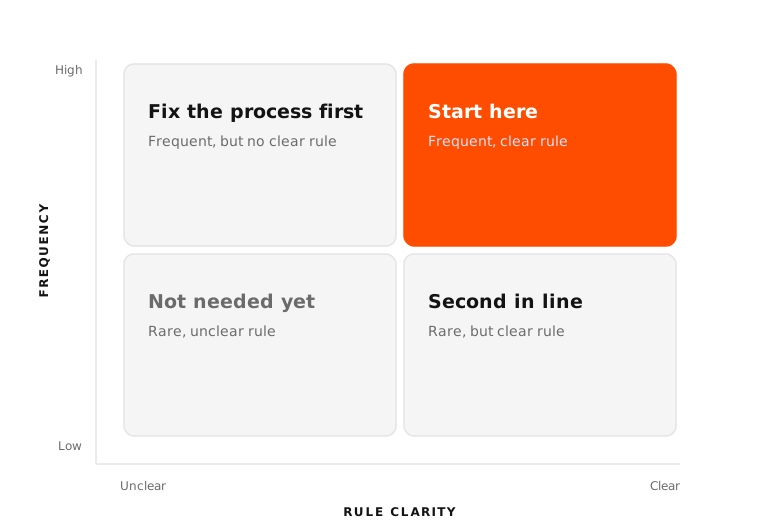
The upper-right quadrant comes first. The lower-left quadrant may never need automating, and that is fine.
Turn it into a number
The criteria help, but the decision gets made with a number. Fill in this table for every candidate process.
| Metric | How it's calculated |
|---|---|
| Frequency | How many times a month it happens |
| Time | How many minutes it takes each time |
| People | How many people are involved |
| Hourly cost | Monthly salary ÷ 168 |
| Monthly value | Frequency × time × people × hourly cost |
A worked example. Document approval: 200 times a month, 15 minutes each time, three people involved, average hourly cost $8.
200 × 0.25 hours × 3 people × $8 = $1,200 a month, or $14,400 a year.
Add errors and delays on top. If automation saves 70% of that time, that is roughly $10,000 a year. If the project costs $9,000, it pays for itself in about eleven months. That is a good return, though every candidate is still worth comparing against the others.
Do this calculation together with your staff, not on your own. They know both the frequency and the time more accurately than you do. It also brings them into the project from the start.
Five steps
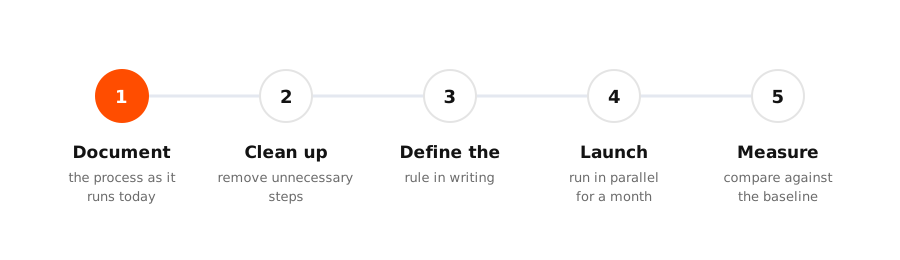
1. Document the process as it actually runs
Write down the real process, not the ideal one. Who starts it, who approves it, where it stalls. This step alone often reveals that part of the process is unnecessary.
2. Remove what is unnecessary
The cheapest step, and the one most often skipped. If an approval chain has four people and two of them have never once rejected anything, they come out of the chain. Do this before automating, or you end up digitising a step that never needed to exist.
3. Write the rule down explicitly
"If the amount exceeds $2,000, the director approves it." Every exception gets written down too. A rule that cannot be written down cannot be automated.
4. Launch and run in parallel
For the first month, the old and new methods run side by side. It is extra work, but it surfaces errors before the old method is retired.
5. Measure
Re-measure the same figures recorded at the start — frequency, time, error count — a month later. Those numbers become the basis for deciding on the next process.
The four most common mistakes
Digitising disorder. If the process is a mess, putting it into a system produces a digitised mess. Order comes first, the system comes second.
Starting too many at once. Automating seven processes simultaneously is too much change for staff at once. Resistance rises and none of them lands fully.
Leaving staff out of the process. The system arrives from above and one day an employee sees a new screen. The fix: bring one or two people from each department into the project as it happens.
Not measuring the result. If no baseline was recorded, there is no answer to "did it actually help" afterwards — and asking for budget on the next project becomes harder.
An employee is not afraid of a new system — they are afraid of being watched, because now what they do is visible. Do not introduce it as a monitoring tool. Show each person specifically what it makes easier for them: faster search, a report that generates itself, no more writing things down by hand.
When not to automate
- The process repeats fewer than a few times a month
- The rule has not settled yet and changes every month
- A mistake is cheap and easily corrected
- The process is planned to change entirely within six months
- The person who runs it, and the process itself, will not exist in the near future
Two of these are enough to wait. That is not inefficiency — it is being economical.
What it costs
Automation comes in three sizes depending on scope:
$5,000-9,000On a ready platform, 3-4 weeks
$18,000-22,000A standalone platform from scratch, 8-10 weeks
$45,000-90,000Enterprise scale, 6-10 modules, 14-16 weeks
The factor that affects price most is the number of integrations. Each connection to an existing system takes one to three weeks.
In summary
Automation does not start with "everything." It starts with one process, and that process is chosen against three criteria.
Practical steps:
- Write down five candidate processes
- Calculate the monthly value for each — frequency × time × people × hourly cost
- Score them against the three criteria and start with the highest
- Remove unnecessary steps before automating
- Record baseline numbers — a month later they show the result
A 30-minute assessment of your project
We review your processes together, tell you which one is worth starting with, and you leave with an indicative timeline and budget.
Discuss your project
Shahbozbek Usmonov
ShahNur Software team sharing lessons from building and running real products.
About the teamRelated articles
Automation
Attendance tracking: cards, fingerprints or face recognition
How the three methods differ, which suits which conditions and how each links to payroll. Working with staff and a practical rollout order.
September 12, 20267 min read
Read more
Automation
Why systems go unused, and how to prevent it
Systems fail through non-adoption, not technology. Five real causes and what to do before the project, during it and after go-live.
September 10, 20268 min read
Read more
Automation
Payroll automation: from three days to two hours
Why payroll takes so long and where the errors come from. Linking attendance, defining bonus rules and a practical order for the rollout.
September 8, 20267 min read
Read moreHave a product idea? Let’s build it together.
Start a conversationOn this page